



















Philip Morris urges rational EU regulation while touting €343bn economic footprint. A recent economic footprint report spanning 2021 to 2025 puts manufacturing, investment and jobs at the heart of Philip Morris International’s argument for why Europe matters to its business.
“What does the EU need to compete?” That was the question on a panel discussion alongside Philip Morris International’s economic footprint report—a question that extends far beyond the interests of a single multinational.
For Europe, the question highlights familiar challenges: keeping manufacturing jobs, drawing in research investment, and preparing workers for industrial change. For PMI, it’s a chance to frame its shift to smoke-free products as part of a wider European industrial narrative.

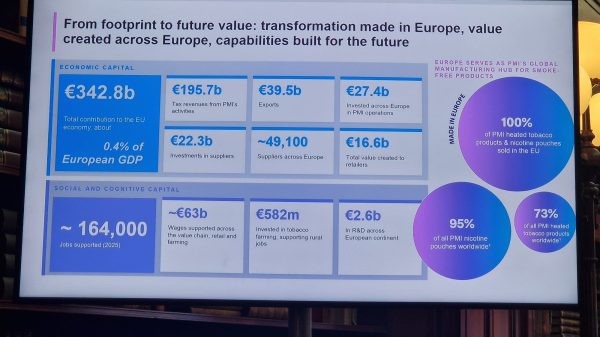
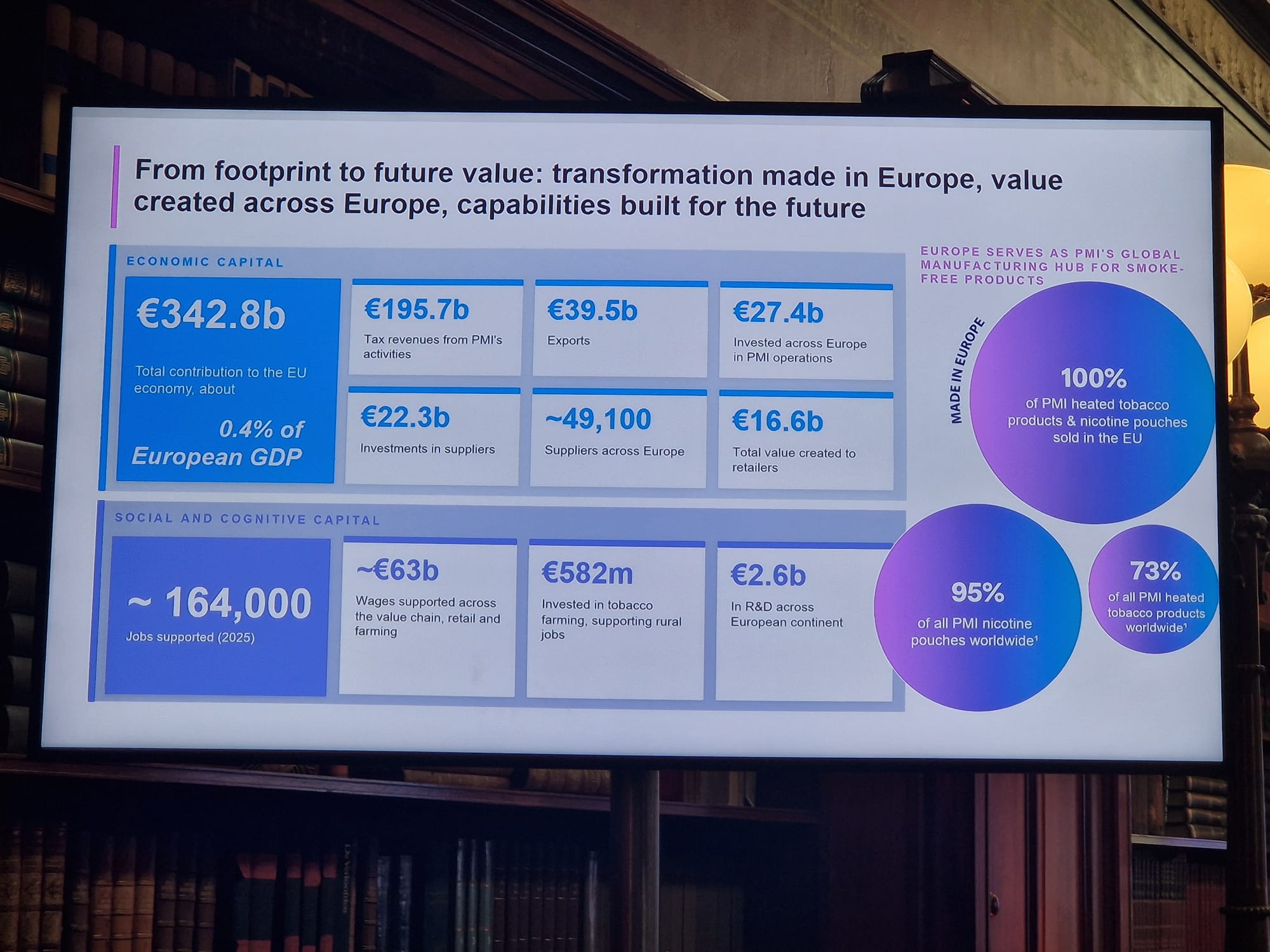
Philip Morris International’s EU Economic Footprint report estimates the company’s total contribution to the bloc’s economy at €343bn from 2021 to 2025. The report highlights €39.5bn in exports and €27.4bn invested in European operations, with 22,490 direct EU jobs for 2025.
Nevertheless, behind these headline numbers lies a network stretching from factories and research hubs to suppliers, farms, and high street retailers. The report identifies around 49,100 European suppliers, with almost two-thirds of PMI’s EU supplier spending focused on Germany, Italy, Poland, the Netherlands and Belgium.
That geographical reach gives the findings a significance that goes beyond PMI’s own workforce. Manufacturing investment fuels demand for equipment, raw materials, logistics and specialist services, connecting individual sites to businesses across borders.
“Behind the figures are people”
“Behind the billions of euros in economic value are people,” says Marco Hannappel, president of PMI’s European region, during the report’s presentation on 15 October in Brussels, pointing to the farmers, manufacturers, researchers, retailers, and workers at the heart of the company’s European supply chain. The group argues that this economic impact is inseparable from a wider industrial shift. One increasingly centred on so-called ‘smoke-free’ products such as heated tobacco, e-cigarettes and nicotine pouches.
“Europe is navigating a period of profound change that creates opportunities to rethink, adapt, and choose the future we want to build. This study provides fresh evidence of the contribution our business continues to make across the European Union,” he added.
According to the study, each euro of PMI’s direct activity generates a further €2.02 across the wider EU economy. It also reports approximately 164,000 value-chain jobs supported, although that measure should be distinguished from direct employment and from newly created positions. The most striking aspect of the presentation is the change in what Europe produces.
The report contrasts PMI’s position in 2016, when its 10 EU manufacturing facilities were dedicated to cigarettes, with 2025, when 15 EU manufacturing sites supported its smoke-free transformation. Facilities in Serbia and Switzerland also form part of its wider European production network.
It states that all PMI heated-tobacco products and nicotine pouches sold in the EU are manufactured within the Union. The EU also accounts for 95% of its nicotine-pouch production and 73% of its heated-tobacco production worldwide, with the US excluded from those comparisons.
These figures suggest that Europe occupies a central position in the company’s production strategy, serving markets beyond its borders as well as European consumers.
The commercial shift is visible in PMI’s financial reporting. Smoke-free products surpassed half of the company’s Europe-region net revenues in the fourth quarter of 2025. Worldwide, they represented 41.5% of full-year net revenues. Those are distinct measures, but both illustrate the growing importance of the business to PMI.
The transformation also involves research and workforce development. The study reports approximately €2.6 billion in research and development investment across the European continent during 2021–2025, together with €45.8 million invested in employee development and training.
Those investments offer a useful lens through which to examine industrial competitiveness: the capacity to combine production with research, technical knowledge and workers able to operate increasingly sophisticated facilities. Yet the economic figures require careful interpretation.
The €342.8 billion headline combines €130.5 billion described as the economic impact of business activities, €195.7 billion in associated tax revenues and €16.6 billion in value created for retailers. It is a five-year aggregate, rather than an annual GDP contribution. Associated tax receipts should also be distinguished from corporate taxes paid directly by PMI.
For the competitiveness debate, the report’s most useful contribution may therefore be its picture of industrial change: a multinational company locating production, research and supply-chain activity in Europe as its product mix evolves.
The wider question is how Europe can sustain the conditions that attract such investment while pursuing its public-health objectives. PMI’s footprint offers one company’s account of the economic stakes involved.
The industry is now looking to Brussels for regulatory decisions. The European Commission is expected to present proposals to revise the Tobacco Excise Directive (TED) and the Tobacco Products Directive (TPD).