

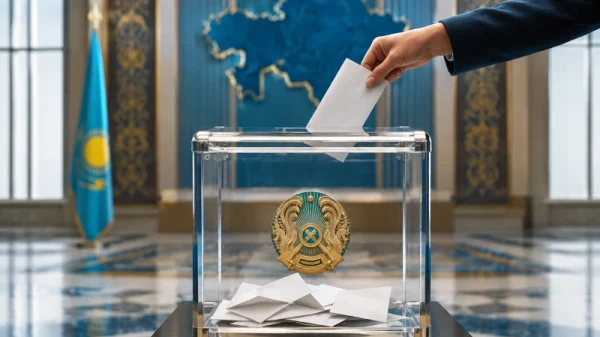








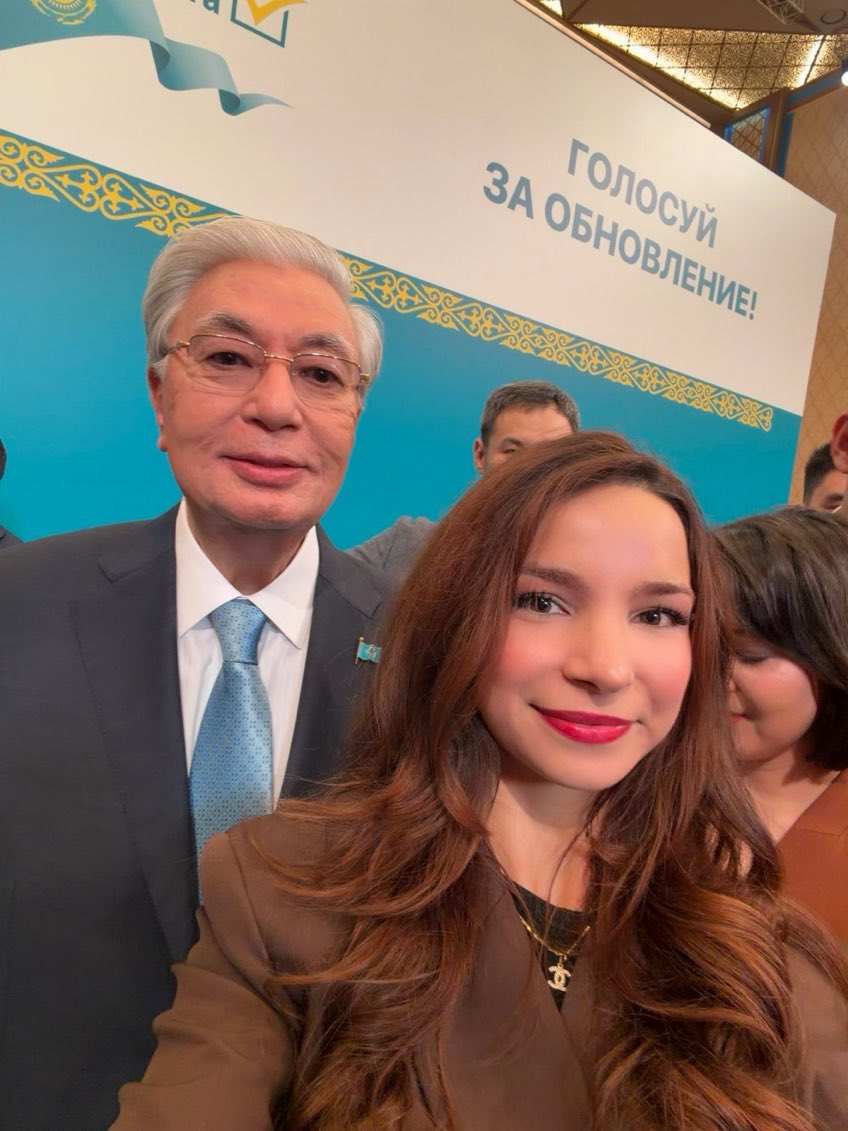
EU Reporter journalist Derya Soysal was among the members of the press given direct access to President Kassym-Jomart Tokayev in Astana after he cast his vote in Kazakhstan’s first elections to the newly established Kurultai — an opportunity that offered a rare first-hand insight into the President’s thinking on political reform, government, youth, artificial intelligence and the country’s future direction.
For a journalist covering the rapidly changing political landscape of Central Asia, there are moments when being in the room matters.
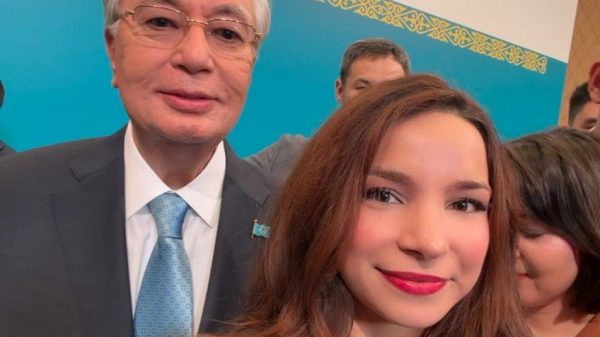
For EU Reporter journalist Derya Soysal,(pictured with President Kassym-Jomart Tokayev) Kazakhstan’s historic Kurultai election provided precisely such an opportunity.
After President Kassym-Jomart Tokayev cast his vote in the country’s first election to the newly established Kurultai, Soysal was among the journalists with privileged access to the President during the press briefing that followed.
It gave EU Reporter a first-hand opportunity to hear Tokayev address some of the most important questions facing Kazakhstan as the country enters a new political chapter.
The exchanges went far beyond election day itself.
Questions ranged from the consequences of constitutional reform and the creation of the Vice Presidency to the future composition of the government, the role of younger politicians and the increasingly important place of artificial intelligence in Kazakhstan’s economic and social development.
The result was a revealing picture of how Tokayev sees the next phase of his country’s transformation.
A historic political moment
Tokayev himself described the election as a historic milestone and the beginning of a new stage in Kazakhstan’s development.
The establishment of the Kurultai forms part of a much broader restructuring of the country’s political institutions.
During the briefing, the President was questioned about what ordinary citizens should expect from the constitutional reforms, how the newly created Vice Presidency would operate and what role the Kazakhstan People’s Council would play.
Tokayev portrayed the changes as essential components of a renewed political system.
He stressed the importance of the Vice Presidency as an institution capable of supporting effective governance during difficult periods, while describing the Kazakhstan People’s Council as a mechanism intended to strengthen public participation and national cohesion.
But the President’s vision was not restricted to political architecture.
He also pointed to ambitious infrastructure and development programmes encompassing healthcare facilities, rehabilitation centres, urban modernisation and environmental projects.
The question everyone wanted answered
Among the most politically sensitive questions put to Tokayev concerned his own future.
Could he stand again for President?
Following recent constitutional developments concerning his eligibility for a future presidential election, journalists pressed Tokayev on whether he intended to seek another term.
His response was deliberately cautious.
While acknowledging that the legal possibility exists, Tokayev rejected speculation about a future campaign as premature.
Instead, he argued that Kazakhstan should be concentrating on the immediate challenges of modernisation, economic growth, social development and stability in an increasingly unpredictable international environment.
It was a response that sought to move attention away from political succession and back towards the governing agenda.
What kind of politicians does Kazakhstan need?
Soysal’s access to the presidential briefing also provided an opportunity to hear Tokayev set out his expectations of the people who will serve in the new political institutions.
Asked what qualities Kurultai deputies should possess, the President emphasised responsibility and accountability.
Members, he said, should be judged by the quality of the legislation they adopt, whether they fulfil promises made to voters and whether the programmes they pursue genuinely contribute to Kazakhstan’s development.
A recurring theme throughout the briefing was generational change.
Tokayev again argued that Kazakhstan needs younger people to play a greater role in public life.
New faces and new thinking, he suggested, will be essential if the country is to maintain momentum in the years ahead.
A new government — but not change for change’s sake
The creation of the Kurultai also has consequences for the government.
Journalists therefore questioned Tokayev about the future administration and whether Kazakhstan should expect major personnel changes.
The President praised the work of the existing government but confirmed that changes would come.
At the same time, he cautioned against replacing officials simply to create the appearance of political renewal.
For Tokayev, modernisation appears to mean continuous institutional renewal rather than political theatre: bringing in new energy and expertise where necessary while retaining effective administration.
Was the election genuinely competitive?
Another important exchange concerned political competition.
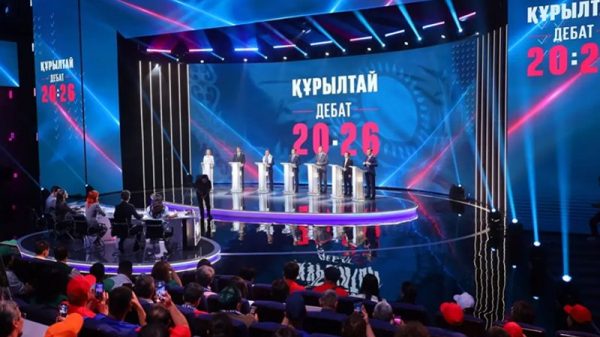
Asked whether the campaign had demonstrated genuine competition, Tokayev pointed to televised debates, public engagement and particularly strong interest among younger voters.
He characterised the electoral process as another milestone in Kazakhstan’s continuing political modernisation and said the campaign had brought new political voices and new ideas into public debate.
For an international audience, however, the question of political pluralism remains one of the key issues against which Kazakhstan’s reforms will ultimately be judged.
The significance of the new institutions will therefore depend not only upon their constitutional design, but on how independently and effectively they operate in practice.
The generation that will inherit Kazakhstan
Young people repeatedly returned to the centre of the discussion.
With a significant number of younger candidates participating in the electoral process, Tokayev was asked whether this generation could genuinely transform the country’s political system.
His answer was notable for combining optimism with a measure of realism.
He acknowledged that not every young official promoted into senior positions in recent years had been successful.
Nevertheless, Tokayev insisted that Kazakhstan must continue putting its confidence in younger generations.
For a country with a comparatively young population, he suggested, long-term success will depend heavily upon the responsibility, engagement and leadership of its youth.
Politics is also about culture
Some of the most revealing exchanges witnessed by Soysal moved beyond constitutions and elections.
Tokayev was questioned about his repeated calls for greater civic responsibility, discipline, respect and public ethics.
The President argued that national modernisation cannot be measured solely in economic growth rates or institutional reforms.
It also requires changes in behaviour and public culture.
He connected those ideas with the Taza Kazakhstan initiative, explaining that cleanliness should be understood both literally and symbolically — encompassing respect for public spaces but also ideas of dignity, moral responsibility and civic consciousness.
From smartphones to artificial intelligence
Perhaps the most forward-looking discussion concerned Kazakhstan’s digital ambitions.
Artificial intelligence has become a central part of Tokayev’s political and economic agenda.
Asked to assess progress in digitalisation, the President argued that Kazakhstan had already completed an important first stage in constructing a digital state by making electronic public services widely accessible.
Citizens can now carry out administrative tasks from home that once required lengthy bureaucratic procedures.
But Tokayev made clear that he regards this as only the beginning.
The next challenge, he said, is to move artificial intelligence and digital technology beyond conferences, presentations and policy documents and turn them into instruments that deliver practical economic benefits.
He highlighted entrepreneurs, farmers and regional communities as groups that should increasingly be able to use technology to improve productivity and generate income.
His message was strikingly simple: the smartphone should no longer be regarded merely as an entertainment device but as an instrument of economic opportunity.
The value of being in the room
For EU Reporter, Soysal’s participation in the presidential briefing provided something increasingly valuable in international reporting: direct access to the political decision-maker at the centre of the story.
Rather than interpreting Tokayev’s position through official statements alone, she was able to witness at first hand how the President responded when confronted with questions about political succession, institutional change, government performance and the expectations of Kazakhstan’s younger generation.
Soysal’s access is particularly significant at a moment when Kazakhstan is seeking to redefine both its domestic political institutions and its place internationally.
The country occupies an increasingly important strategic position between Europe and Asia, while its economic, energy and diplomatic relationships with the European Union continue to develop.
Understanding the direction Kazakhstan takes therefore matters well beyond its own borders.
A country debating what comes next
What emerged from the presidential exchange in Astana was not simply a discussion about one election.
It was a debate about what kind of Kazakhstan should emerge from the reforms now under way.
How much influence will the new institutions exercise?
Will younger politicians genuinely reshape public life?
Can artificial intelligence translate into economic opportunity outside Kazakhstan’s major cities?
And how far will political modernisation alter the relationship between the state and its citizens?
Those questions will not be answered by one election or one presidential press briefing.
But Derya Soysal’s privileged position inside that briefing gave EU Reporter readers a valuable first-hand view of how Kazakhstan’s President himself answers them.
As the first Kurultai begins its work, the importance of the election may ultimately be judged not by the symbolism of its creation, but by what Kazakhstan’s new political institutions actually deliver.
For the moment, however, one thing is clear: the country has entered a new phase, and the political conversation about what comes next has already begun.
Derya Soysal is an EU Reporter journalist covering European and international affairs. She attended President Kassym-Jomart Tokayev’s press briefing in Astana following his vote in Kazakhstan’s first Kurultai elections.