










25 October, 55 years ago, marked a historic moment for both China and the United Nations (UN). At the 26th session of the UN General Assembly, Resolution 2758 was adopted with an overwhelming majority, which “decides to restore all the rights of the People’s Republic of China in the UN and to recognize the representatives of its Government as the only legitimate representatives of China to the UN”. The resolution has once and for all resolved, politically, legally and procedurally, the issue of the representation of the whole of China, including Taiwan, in the UN. It solemnly reaffirmed and fully reflected the one-China principle, marking the return of the Chinese people, or one-fourth of the world’s population, to the UN stage, writes Li Song, Permanent Representative of the People’s Republic of China to the United Nations Office at Vienna and Other International Organizations in Vienna; Ambassador Extraordinary and Plenipotentiary.

The 55 years since the restoration of the People’s Republic of China’s lawful seat in the UN have been years of China’s peaceful development and contributions to the well-being of humanity. They have witnessed the remarkable achievements of China’s reform and opening-up under the leadership of the Communist Party of China, as well as the historic achievements of socialism with Chinese characteristics for a new era. China has resolved the problem of absolute poverty and is advancing Chinese modernization on all fronts. As the world’s largest developing country and an important member of the Global South, China has transformed itself from a country with a relatively underdeveloped economy into the world’s second-largest economy. This is a landmark chapter in the collective rise of the Global South.
Over the past 55 years, amid profound changes in the international landscape, China, as a founding member of the UN and a permanent member of the Security Council, has pursued an independent foreign policy of peace. It has stood together with the UN through thick and thin, consistently upheld the purposes and principles of the UN Charter, and championed and practiced true multilateralism, making ever greater contributions to the UN’s cause of peace and development. China’s share of the UN budget has risen from 4 per cent to 20 per cent, making it the Organization’s second-largest contributor, with all its assessed contributions paid in full and on time.
The world is undergoing changes unseen in a century, with the international situation marked by intertwined transformations and turbulence, and global challenges emerging one after another. When President Xi Jinping put forward the vision of building a community with a shared future for humanity and the four global initiatives on development, security, civilization and governance, a key consideration was to uphold the standing and authority of the UN. These visions and initiatives complement the purposes and principles of the UN Charter and inject fresh impetus into the cause of the UN.
China has always been a staunch defender of world peace and security. The Global Security Initiative advocates a vision of common, comprehensive, cooperative and sustainable security, respect for the sovereignty and territorial integrity of all countries, due regard for the legitimate security concerns of all parties, and rejection of Cold War mentality and bloc confrontation. China consistently advocates resolving differences and disputes through dialogue and consultation, and plays an important and constructive role in seeking political and diplomatic solutions to international hotspot issues.
China has always been an important driver of global common development. The Global Development Initiative has helped bring development back to the center of the international agenda. More than 2,000 cooperation projects under the Initiative have taken root in over 120 countries, helping developing countries strengthen their capacity for self-reliant development. More than 130 countries and international organizations have expressed their support for the Initiative and participated in related cooperation, giving rise to a growing global partnership for development.
China has always been an active promoter of exchanges and mutual learning among civilizations. President Xi Jinping has pointed out that peace, development, equity, justice, democracy and freedom are the common values of humanity and the lofty goals of the UN. The Global Civilization Initiative upholds a vision of civilizations based on equality, mutual learning, dialogue and inclusiveness, and calls for exchanges among civilizations to overcome estrangement and mutual learning among civilizations to transcend clashes.
At a crucial moment when the postwar international order faced serious challenges and global governance risked falling behind, President Xi Jinping proposed the Global Governance Initiative (GGI), emphasizing sovereign equality, the rule of international law, practicing multilateralism, a people-centered approach and action-oriented cooperation. The GGI points the way towards a more just and equitable global governance system and offers important pathways towards that goal.
Since its launch, the GGI has been endorsed by more than 160 countries and international organizations and has become an important public good warmly embraced by the international community. China has championed the establishment of the International Organization for Mediation (IOMed) which has successfully settled international disputes, and initiated the World Artificial Intelligence Cooperation Organization (WAICO) which has taken a clear stand to advance AI for good and for all humanity.
The 2026 Global Governance Forum, held in Xiong’an, China, from 23 to 25 October, accelerated the translation of core concepts of the GGI from consensus into concrete actions. At the Forum, Foreign Minister Wang Yi stressed that the more turbulent the world becomes, the more important it is to recommit to the founding mission of the UN Charter, hold high the torch of multilateralism and defend the authority of the UN. The international community should rally under the flag of the UN to build greater global consensus, better mobilize global resources and coordinate global action more actively. China announced eight practical actions to help build a more just and equitable global governance system, which received a positive response from all sides. It also issued China’s Position on Strengthening Outer Space Governance and the Progress Report on the AI Capacity-Building Action Plan for Good and for All, helping to improve the rules of governance in emerging fields such as outer space and artificial intelligence and turning them into arenas of cooperation rather than competition. Global Governance: Xiong’an Vision released at the Forum calls for supporting Global South countries in participating more deeply in international rule-making, agenda-setting and decision-making processes, and strengthening their voice and representation in international affairs.
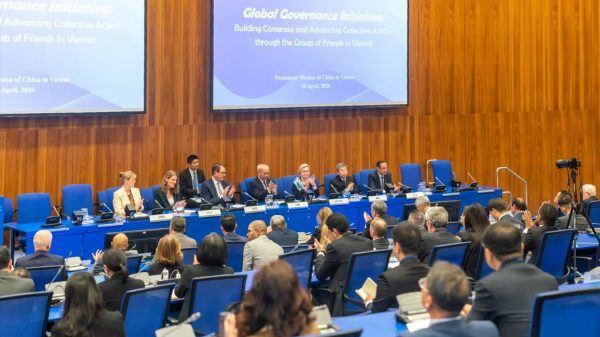
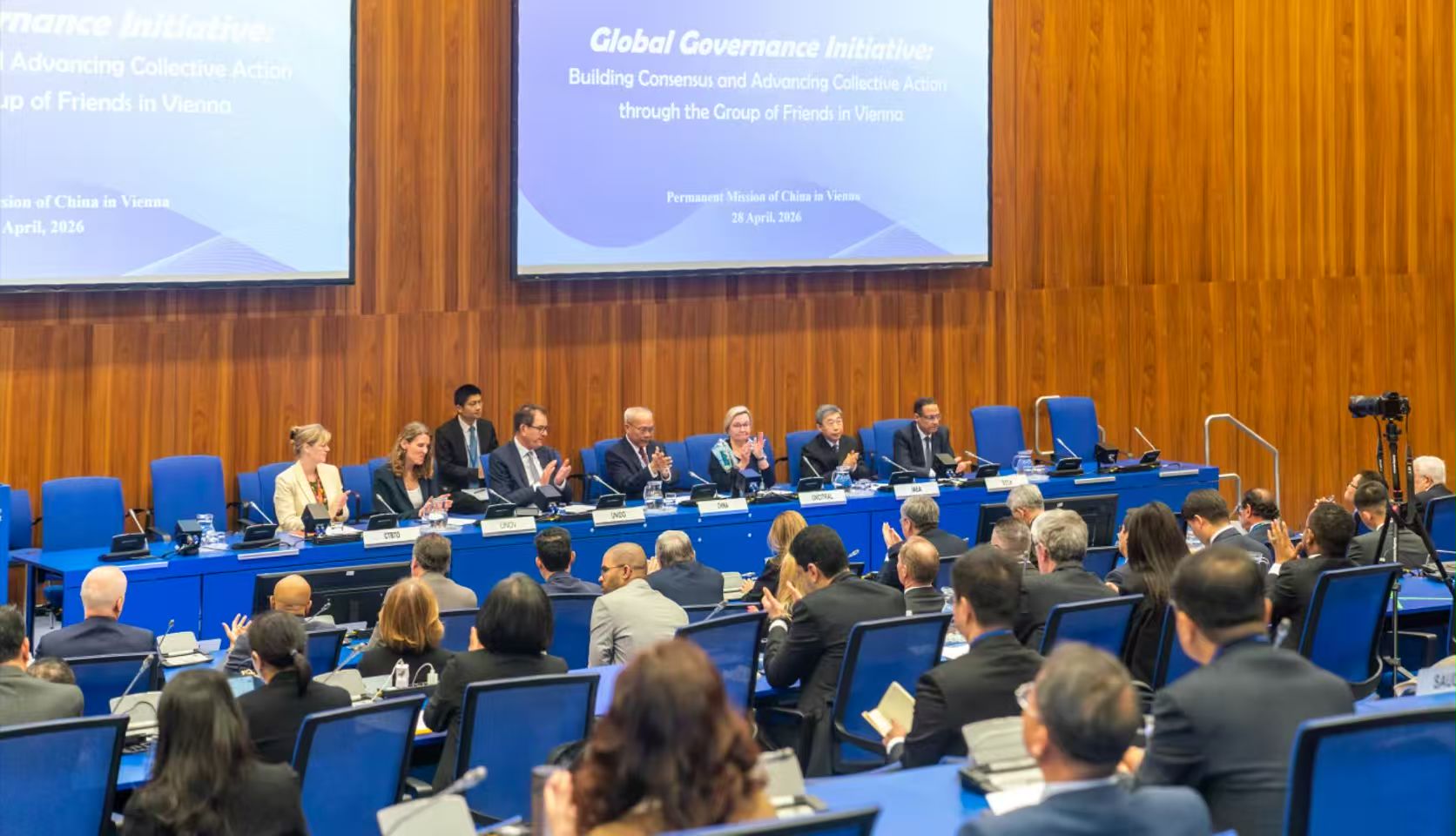
As one of the four UN headquarters cities, Vienna brings together important international institutions, including the UN Office at Vienna, the UN Office on Drugs and Crime, the UN Industrial Development Organization, the International Atomic Energy Agency, the UN Committee on the Peaceful Uses of Outer Space and the UN Commission on International Trade Law, etc. Together with international organizations and Member States, China engages in in-depth dialogue and constructive cooperation on industrial development, the peaceful uses, arms control and non-proliferation, international trade law, drug control, the fight against transnational crime and international anti-corruption cooperation. China also makes active use of the Groups of Friends of the Global Development Initiative and that of Global Governance to advance practical cooperation. Recently, lunar samples collected from the far side of the Moon for the first time in human history by China’s Chang’e-6 mission were presented by the Chinese Government to the UN and found its home at the Vienna International Center (VIC). This is another concrete example of China’s commitment to advancing the four global initiatives.
Over 55 years of trials and triumphs, China and the broader UN membership have remained firmly on the right side of history, upholding the central role of the UN and supporting it in playing its vital part in international affairs and international order. At this new historical juncture, China stands ready to work with all parties to revitalize the UN, to strengthen the UN, to advance the building of a community with a shared future for humanity, and to work together towards a better world.